VG, June 17, 1999
The VG op-ed which eventually became informally known as “The Manifesto of Indoor Football”
By Frank N. Hartvedt
As Egil “Drillo” Olsen has been applauded by virtually the entire press for nearly a decade, worshiped by the grassroots desperate for something or someone to look up to and look forward to, he can hopefully withstand a different voice. I feel that Drillo’s entrance as a manager of Norwegian football is the main reason behind my everyday frustrations.
There are two types of football players: those who like the game, who hang Spurs’ scarves on the wall and run screaming around the village green with their mates and the ball between their legs, and those few who love the game.
Since I was a little toddler, I have been entirely devoted to the game. When my 16-year-old peers started raving and drinking at the local discos, Frank took the ball in his arms and raced towards the pitch. Often alone. It could naturally be tempting to indulge in other youthful antics, but not for me. Football overshadowed everything. Always. Lack of perspective? Well, it doesn’t matter. I had a great time, that’s for sure. Why a few are like this, I don’t know. Perhaps early on you notice that you master the game in a different way than your mates, that you have the feeling that you know exactly how you should perform the various techniques.
I don’t know how many hours I have spent polishing the touch and the sensitivity in my feet. What I do know very well is that I have gotten better and better. Let me put it this way: My own performance alone on the village green, as well as with club mates, has made it impossible for me to be impressed by the so-called great players who receive total coverage on television. With head held high, I can secretly say with certainty to myself that I can also do that, with ease.
For years I’ve heard Drillo and his disciples say that Norway, due to its geographical and climatic status, is a relatively poor breeding ground for producing as many technical talents as, for example, Brazil. That is wrong. The one who has loved the game through the years as I have, and who has only used the surfaces that existed when winter raged at its worst, knows that this is wrong. They feel it on their right feet. It is therefore not natural factors that come into play; it is instead the individual players’ relationship to the game.
Loser Attitude!
How do we then motivate more people to become lovers of the game? How do we get more people to become fans of the game? Believe me, it at least helps to not succumb to Drillo’s loser attitude. “We are no better. Unfortunately, we don’t have the abilities to compete with the major nations. We must therefore plan the game accordingly.” A winner would have said: As of today, we’re not good enough (we have too few who love the game). Let us use the time well in order to improve so that, in the long run, we can beat them on their terms with what football is all about; namely, art.
Drillo has focused on football as a science with computer technology, performance insurance tools, etc. Football has become a craft. The one who was chosen as number five on the village green is the great hero today, while the one who was the first choice, the boy who exceeded them all with divine feints and passes is called the dimwit, the one who doesn’t fit in the system.
Talk as much as you like about efficiency, lacking abilities and expertise. Drillo should at least know that he has killed much of the joy of the game in those who love it. He is likely very aware that he is associated with holiness among his colleagues in the country, and he is surely also well aware that these people are unconditionally loyal to him. I see this.
The other day, I happened to attend a little league game during which little Anders ran circles around his opponents using his glorious skills.
“Anders, if you continue like that, it’s straight out for you. A touch and in the longitudinal direction, like we talk about during training.”
I wanted to shake him, and it wasn’t difficult to track down the resigned facial expression of a boy who had been “slammed” by a man blinded by success on the national team who was incapable of knowing how much fun this boy had been having.
That is why I will never understand how Drillo, who had allegedly been a sensitive player himself, can have the conscience to promote this type of football. When he was younger, he surely stood, just like everyone else, and hailed Kniksen (Roald “Kniksen” Jensen) who danced around on the pitch. It often cut across, and also backwards – and time – it took a very long time, but it was wonderful to watch, wasn’t it? It was art, and you could see Roald have fun.
Denies enjoyment
Drillo is the man who denies Frank Hartvedt enjoyment. As a junior player, I played on a reasonably decent Bergen team. We had a fantastic time. We had a manager who obviously knew what it meant to draw away three players with a small, specific twist of the ankle joint. He saw how much fun it was to dribble past three players and to do the same again after they had passed, and he let us do it. The issue was never efficiency versus ball possession. It was efficiency versus self-determined fun. Football on the village green.
Then I went over to a better club and met the scholars. They were Category C, F or G-managers. They possessed sound knowledge of the discipline. Discipline? What happened? Since when did freestyle football tricks and well-placed “jabs” become a discipline? Well, well – with the P-managers, the frustration felt was deep. Previously, during events with the regional and West Norway select teams, I had sensed the “new era”, but had brushed it off during team training. Now, it was in my club; zone defence, longitudinal direction, breakdowns and no mercy for those who dribbled backwards or who had the ball at their feet for more than three seconds. “We must be true to the system, boys.” The manager’s familiar comment. Nice people, by all means, but had they ever been able to hit the ball with their instep more than 20 times? Were they embarrassed just to suggest that they should teach my talented teammates to play football? Oh, no. They were V-managers.
The whole year was dominated by clashes between managers who talked about fixed patterns and shocked players who were uncomprehendingly fed with so-called work tasks in so-called roles. The joy we had experienced on the village green had become a stressful school paper. The managers decided our steps. We complained. We were disloyal. Yes, of course we were. I didn’t start loving the game because it was so fun to run or tackle or jump. I loved the game because I got to play with the ball. Now, there were people with papers who told us that football was controlled play at best, and many pointed their fingers. And Drillo is the man behind much of this.
I have been injured a lot lately, but I have, among other things, managed to try out for an eliteserie (top division) club, and no – I didn’t fit in. I was literally told that my technique differentiated me, that I was one of the least conventional players they had seen. And yes, it would certainly take a long time to retrain me!
Contradiction
Look at that ball genius. Look at the receiving. Look at those responsive passes! Drillo’s own words. He was practically flustered when he spoke about Zinedine Zidane on TV. Three players were deceived. No momentum. And ultimately, a support pass. I have several similar examples where Drillo uninhibitedly praises “ineffective” ball talent to the skies. This extremely annoys me. Performance that would have been severely criticized by him and his disciples at the dull Norwegian club training sessions, are now to be worshiped. I become confused and bitter.
For what would have Zidane made of the work tasks handed out by Drillo? Oh, yes. He would have accommodated Drillo’s domineering words – he’s a class player after all! Or would he have been frustrated by the fact that Drillo had taken away the freedom of choice, the sense of play? He would not have accepted it. As with the other sensitive top players, he would have been nothing without his own freedom of choice and creativity. Drillo has made the manager into a hero or a scapegoat. Through his writings, which I have read, he has deprived the players of a great deal of “power” and made the manager’s decisions crucial.
I see little hope for my possible career in the future, here in the country at least. I will probably end up taking my bag and going south. Adjust myself to the circumstances here? Football isn’t fun anymore, Egil Olsen. The training sessions have become a chore. Remove all the warnings and requirements and put me up against any player. I will do it well because I will get to act myself, make my choices with the ball and pick from my archive of learned skills. And I will have fun.
Fun. Results are the most important. Those are what are remembered, it is said. I don’t know how Egil Olsen looks at life, but I always put happiness and enjoyment at the top, and ultimately, it is the playing of the game itself that makes one happy, not the results. Better to lose a game exercising one’s freedom of choice and having fun than winning one with rigid demands and systems. I think that in time, one could have one’s cake and eat it, too, as the saying goes, but Egil “Drillo” Olsen came and destroyed it all – for me.
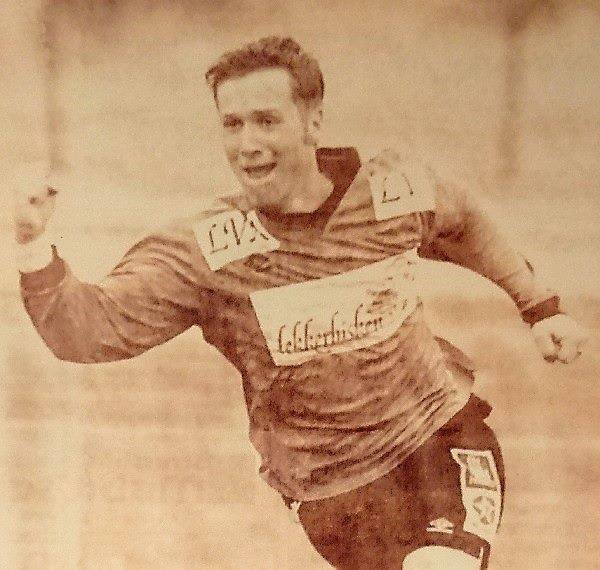
(Image: Facsimile from Bergens Tidende, 1996)