By Frank Benjamin Horn Hartvedt
Your father was unique among the Pentecostals in Bergen at that time. Evangelist Yngvar W. Andersen
In the autobiographical philosophical manifesto, The Frank Benjamin-series, I have shared stories from my upbringing, where I was steeped in the Christian faith. My father, the pastor Frank August, died when I was 17 years old, after turning down hospital treatment on the grounds that God would heal him. A few years after the event, I was no longer a Christian young man.
But: I carried a legacy with me.
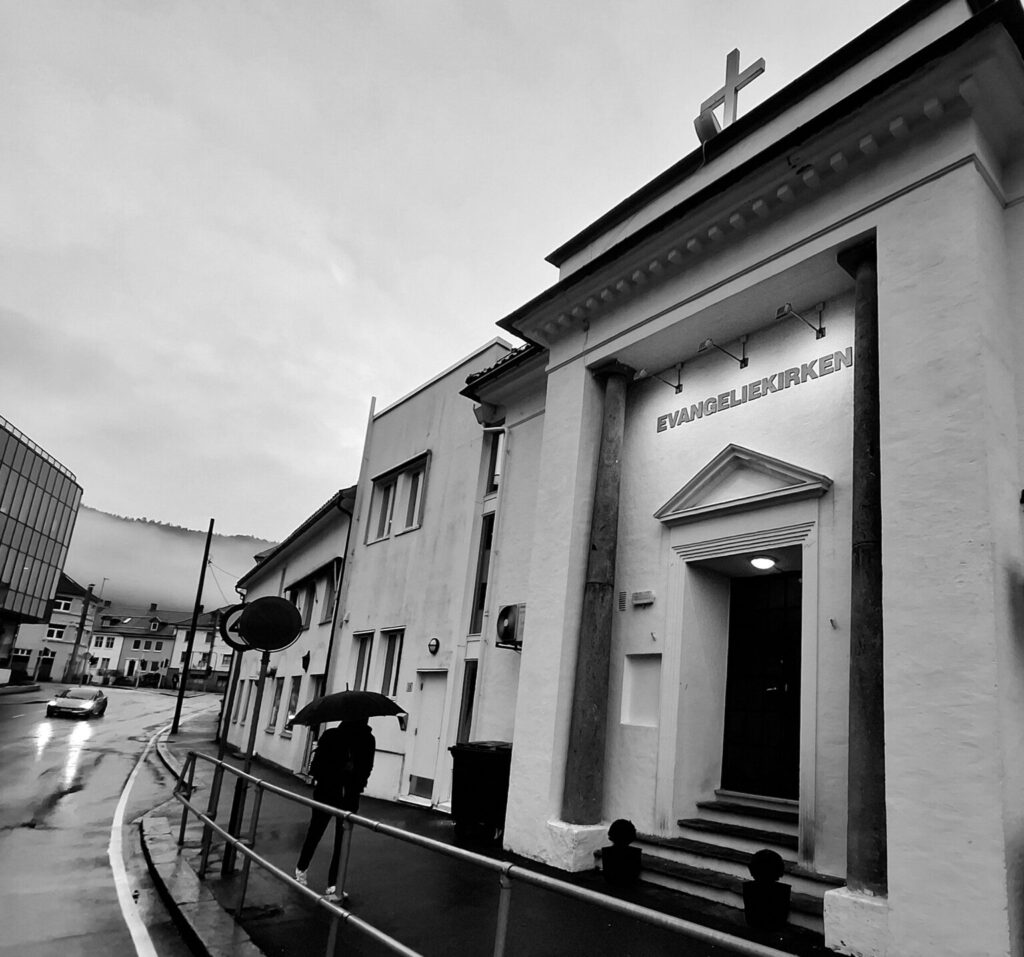
Today, I called Yngvar Willy Andersen (67), the well-known evangelist in Norwegian Christian circles who today speaks to thousands of people, including in Africa. More than 30 years ago, he led the Milde Due (Gentle Dove) Congregation in Åsane in Bergen together with my father, who founded the congregation in 1987/1988.
I remember Yngvar Andersen well. He was an engaged and pleasant man. A few years after my father founded the congregation, he asked Yngvar if he would take over as the presiding pastor. At that time, Yngvar Andersen was in his mid-30s, while my father was in his mid-50s. The idea was for my father to receive leadership assistance in a very hectic congregational life and transition into a role as “Chairman of the Board.” Yngvar accepted.
When I called Yngvar today, I was anxious to hear what he had to say about their time at Milde Due. The main reason for this is that the collaboration with my father eventually soured. But I can say this right away: I was deeply impressed by Yngvar by the end of the conversation. Fascinated. And happy. Because Yngvar honored my father in a way I have rarely heard before. Their conflict was completely overshadowed.
Your father was a man who wanted to go his own way. He thought outside the box. Yngvar W. Andersen
“Your father was unique among the Pentecostals in Bergen at that time. He was charismatic and genuine, and he earned credit for that among all the preachers in the Bergen area. The period with your father left a mark on me; he inspired me in many ways. He let me pursue a dream I had of building up a congregation, and in this congregation, there were not only services but also exciting TV work that I became very involved in,” Yngvar Andersen says.
“Your father was a man who wanted to go his own way. He thought outside the box. At that time, most things were expected to go through the Tabernaklet Congregation in central Bergen. You weren’t really supposed to start something of your own. But your father did. And especially regarding the TV initiative, he was original – a pioneer. He was one of the first preachers in Bergen to obtain a TV license, and once he had it, he had no problem collaborating with other TV actors who did not share his view on life. That was not common. Other Christians involved in TV work at the time preferred to only collaborate with people who shared their faith in God. But your father was broad-minded. He was generous and inclusive; he had one main goal: to reach out with the Gospel.”
And if anyone mastered the art of reaching out with exactly that, it was my father, according to Yngvar Andersen.
“He was extreme, I would say, if I may use such an expression. It’s perhaps more common to use that word in the sales industry where I worked for many years. People were hit by his speeches, right in the heart. He was unique when it came to engaging people with his inspiration, joy, and his burden for people who were often “prodigal sons.” There were quite a few of those at Milde Due. He moved people. When you talked to people in Pentecostal circles in Bergen, many said exactly these things.”
Your mother was a moderator for your father. … She backed your father in a fantastic way. Yngvar W. Andersen
“For me, he opened the door wide and really let me step up as a leader. There was a very good and hearty atmosphere in the congregation, with an openness to God and the Holy Spirit in every way. People were concerned with each other’s well-being. They cared for one another. In a way, Milde Due was a “care-congregation” for people who didn’t fit into a square pattern,” says Yngvar Andersen. He mentions, among others, the couple Martha-Liv and Atle Andersen as key people in the leadership. I understand that well. Those two were gold.
Regarding the collaboration between my mother and father in the congregation’s leadership, Yngvar says this:
“They were a great fortress! They were the core of the congregation and the exponents of the warmth and commitment in the assembly. Your mother was a moderator for your father. She could calmly and cheerfully say to him when we were all sitting there talking: ‘Quiet down a bit now, Frank.’ She backed your father in a fantastic way. I admired the way the two of them reached out their hands to people who were often in despair.”
But he also says this:
“I occasionally thought: ‘How are the boys doing?’ You two brothers had to endure your parents being “on” all the time with congregation work. Caring for many people requires a lot.”
Yet, he understands well that I was deeply inspired by seeing my mother and father work and interact. He was a pastor’s son himself and remembers well the inspiration he received from his own father.
I can understand that you felt a bit of rebelliousness in you … . I fully understand that your experiences … may have led you away from the faith. Yngvar W. Andersen
During the conversation with Yngvar, he said something that surprised me a little. He mentioned that my brother and I attended fewer meetings in the congregation as time went on. “Your mother and father thought it was a bit sad,” Yngvar says. I cannot remember this.
“You were well-developed youths who had your own opinions and standpoints. Your mother and father respected that,” says Yngvar.
“What would you say about my father’s doctrine of faith?”
“He was, after all, a literalist and clear about what was sin. But he was generous and loved all people regardless of who they were.”
“And Hell?”
“We Pentecostals know the art of painting a grim picture of Hell,” Yngvar laughs. “But it was more like that before; now there is more focus on being saved and winning Heaven. This matter of Hell, which is indeed a fact in the Bible, is complex to convey to children. Your father was known for being very clear and consistent in his delivery of the Word. The testimony from other congregation leaders was that he was very clear in his doctrine and speech. I wouldn’t say it was blameworthy of your father to be clear about what Hell was to his children. We are all different, we parents. This is a subjective thing. But clearly, one should be cautious when teaching children about Hell. I am thinking of things like the use of voice and imagery.”
He himself did not have nightmares growing up. But he could wake up abruptly, fearing perdition, he says. “Then I was terrified!”
I tell him that I had a good and safe upbringing, but also an upbringing characterized by a rebellion against nature. Against nudity. Against sex.
“Back then, it didn’t take much before something was called porn. As Christians, we shouldn’t indulge in pornographic magazines, for we are not to be of this world. Your father was perhaps strict when it came to this area. He had his standpoint and his perspective. We parents are different. I can understand that you felt a bit of rebelliousness in you because of this, that you reacted to it. And that is just how life is. You grow up, gain your own opinions, and make your own decisions – some very early. I fully understand that your experiences in this context may have led you away from the faith. I wasn’t exactly a saint myself before I took a very clear stand to follow Jesus at 15. I decided to follow Jesus as early as age nine, but in the years until I turned 15, I allowed myself to be tempted by things I found exciting and that I was supposed to stay away from. I went to the cinema in secret, for example. Why shouldn’t I be allowed to do something as exciting as going to the movies? But I eventually made an independent choice to live as a Christian.”
Your father was very “expansive.” Yngvar W. Andersen
Okay, so, can Yngvar Andersen remember several people in the Milde Due Congregation walking around the Teigland car dealership in Åsane seven times in the hope that God would bless them with the building?
“I wasn’t part of that exactly, but I remember that your father and I had a meeting with Teigland, who wanted to sell the building. Milde Due had seen great growth, and we were looking for new premises. We prayed that God would grant us the building. Acting like Joshua was probably about creating goodwill,” says Andersen.
He says that my father was very “expansive.” But not like his “role model” Aril Edvardsen, who planted congregation activities in many places. My father wanted to expand his congregation locally.
“He wanted to make the Milde Due Congregation large. It may well be that he had “world visions,” but I experienced that his dream was mainly about that one congregation,” says Yngvar.
All was well for a long time between my father and Yngvar Andersen. They respected each other. But then my father became disappointed. Yngvar was very busy with TV work and did not have the capacity to also act as a shepherd for the congregation members to a high degree – due to his sales work. The pastoral care was insufficient, my father believed. And this created a certain strife between the two leaders. I told Yngvar that I specifically remembered an episode in that connection. Yngvar was at our family home, and in a conversation between my father and Yngvar, things got heated. My father then shouted: “There are children here, Yngvar!” Yngvar Andersen actually remembers it, and he chuckles lightly.
“It was a sad and peculiar end to the collaboration. I guess I was flat-out fired. At a congregational meeting, your father got the members on his side during the vote, and I had to leave,” Yngvar shares.
And then come the golden words:
“But even if a collaboration ends as a result of disagreements and perhaps strife then and there, you still retain respect for one another. Because think of everything we had together, all the good memories. This has always overshadowed the conflict and has always influenced me,” says the wide-reaching evangelist Yngvar Willy Andersen.
(This article was published on frankbenjaminhartvedt.no in May 2025)