This is the extended record subsequent to April 14, 2026. It will be written here, continuously.
Note: The curated material may come from a distant or near past – or from the present.

Note: Maksima’s digital status quo is that frankbenjaminhornhartvedt.com, maksimalism.com, and themaksimaeternity.com are live. The next launches are erosrebellion.com, thelittlehorn.com, maksima.org, and themaksimalist.com.
Note: The list of the accused is now presented at The Antichrist Tribunal. Read the indictments.
October 14, 2026 | The Whispers
One day when I was in my early teens, a friend who I sometimes played football together with in Barkaleitet, came to me, astounded: “Frank, you’ll never guess what I heard the other day. I stood behind some of the old guard of Åsane IL at a match and they talked about you. They said: ‘Frank Hartvedt is the next big talent in the club after Kenneth Storvik!’” Storvik was the club’s elegant playmaker, the big name. Regardless of how accurate the assessment was, I remember feeling joy hearing it. But importantly: It was them whispers. Them whispers that talked about someone coming. It was mythical, in a sense. Even though we were just kids.
October 14, 2026 | The Same Date of Death
Just over a month ago I made a discovery that left a considerable impression. I discovered that my father Frank August Hartvedt (Christianity) and Murray N. Rothbard (absolute freedom) died on the same day in 1995 – January 7. When I published The 22 Assertions earlier this year, I noted my father’s date of death in the fourth assertion. In the sixth, I wrote about Rothbard as the most significant intellectual influence in my life. I did not know then about their shared date of death. This is nothing less than an extraordinary and utterly incomprehensible discovery. Several months ago, I defined these two men as the two most important men in my nearly 50-year life, among the thousands of people I have met or been influenced by, not to mention the millions of people I have seen in real life or on television/internet. And then I find out that precisely these two men died on the very same day. They did not share a birthday. They died on the very same day. Let me be blunt: This is the closest I have ever come to something supernatural in my entire life. That is exactly how I look upon it now.
October 14, 2026 | Working Tune
While the ink is flying these days, I’ve got this one playing in my ears. It eventually became one of the signature songs in the IFS movement. Here it is performed in one of the most iconic events in rock history. I’ll leave it up for a day or so.
October 14, 2026 | On Emotions
Jesus of Nazareth is one of many influential figures in history who had a notion about which emotions a person should let into their life. If you are a free man or woman – devoid of “spooks” – you listen to no one but yourself at the end of the day. Fear and terror, rage, sorrow, love, ecstasy and elation, hatred, vengefulness, jealousy – all these emotions are to be counted among those that can reach the highest intensity. I personally love them all. There is an expression called “to embrace it all.” That is exactly what I do when it comes to these emotions. Let us take hatred, for example. If, after careful consideration, you conclude that your hatred toward one or many people is completely justified, then you cultivate the hatred with delight. I love the feeling. If I feel a desire of revenge – because an injustice has been committed against me – then I cultivate it with pleasure. I love that feeling. Love and elation you of course cultivate with gusto. It is truly a delicious feeling to embrace all these emotions. All within the framework of The Maksima Declaration.
October 13, 2026 | For Thee
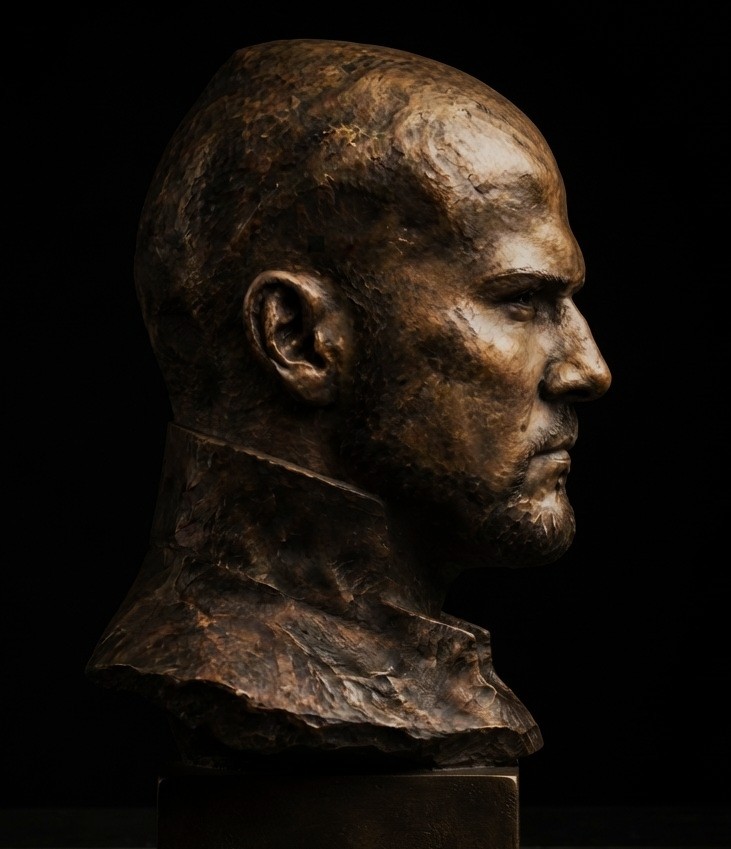
To me – at this very moment – it feels natural to publish this image. I look upon it as – natural, to do so. Tomorrow I turn 49 years old. The bust you see in the picture is a visual representation of how the bronze bust I will possess in one year and a day will look. The motif will be this photograph of me from an article in the local newspaper Bergens Tidende in January 2002. The bust will mark that the age of Maksima has truly commenced.
October 12, 2026 | “All, All Shall See”
In The Frank Benjamin-series we read that the inspired pastor Per Braaten goes through the characteristics that together constitute the advanced human being, the Antichrist – the man who in cunning fashion shall seduce an entire world as a false Messiah. He will preach a gospel that is different from the one found in the New Testament.
In my childhood my beautiful and dear mother often sang “Alle, alle skal se” – “All, All Shall See” – a well-known line from the refrain of a Norwegian hymn – a Norwegian version of “Everybody Should Know” by Mrs. Frank A. Breck and Edwin O. Excell. I loved hearing her sing it to me, and she often told me that everyone would come to see Jesus Christ when he one day returned to earth. She was exceedingly glad about all the development in the field of television. CNN had come to stay, and one day the live televised return would surely come. She said this several decades ago. Since then, technological development has been astronomical – not only in television. The internet is a welcome supplement.
In an increasingly civilized world, where the danger of a new world war is small, the stage is set for the Antichrist to win the spiritual battle with his word – not with missiles, as Braaten suggests he might. The word. And word-seduction as the central tool. In the end, all will see. On CNN and other outlets – on all kinds of screens.
October 12, 2026 | The Commencing of the Age of Maksima
The classical philologist said: “I welcome all the signs indicating that a more manly … age is commencing.” I say: “I welcome all the signs indicating that a more maksimalistic age is commencing.” Today I state: “I welcome all the signs indicating that the union of maksimalists is rising.”
Maksima.org will be up and running next year.
October 10, 2026 | The King and His Heirs
If you have a direct line to a deity, and in addition you might be wearing some adornments, then of course you have power like no other. Every day. History has shown countless times how terribly wrong it can go. “Simple” believers have even willingly gone to their deaths because their shepherd said that was the way to go about.
I felt embarrassed when I visited Sarons Dal – the Valley of Sharon – in Kvinesdal a few years ago. I went there to reminisce a little about childhood holidays from my Christian upbringing, and I attended one of the evening meetings. The meeting leader was none other than the founder Aril Edvardsen’s son and successor, Rune Edvardsen. After nearly an hour of fundraising with bank terminals and everything, he stepped up onto the podium. And the neverending pontificating began at once. Basically it was about his position as chieftain of his father’s faith empire. Below the pulpit sat the Bergen native and leader of the Pentecostal movement in Norway, Øystein Gjerme, and his wife. Gjerme, also leader of a thriving church based in Bergen, was scheduled to speak that evening. Suddenly Edvardsen glances down at the couple and says: “It’s nice to have the crown prince and crown princess here today.” I could hardly believe what I was hearing. And I thought: “In the end, I guess, that’s what it’s all about.”
The whole scene made me think of what Anne Bancroft, aka Amanda, says in the movie Point of No Return (1993): “I never did mind about the little things.” Cause listen: When you think big, you can still sometimes think about the little things – for strategic reasons. “Make an example of” is a central expression in that connection. Tell the story of all the nonsense and wickedness in one territory – in many areas of life – and you have told the story of them all – given the reigning spirit in the world we now live in.
October 10, 2026 | “Beyond the Thunderdome”
I say this: Today we live in a world where submission (and busybodiness) triumphs over the autonomous will. It is like that by default – everywhere. Know this: Even though this situation seems eternal, and most people seem to condone it – indeed, want it – many people do not. It may take centuries to change this world’s way of thinking and living. The pen is sharpened. Today.
October 10, 2026 | The IFS Storytelling Was Decisive

The IFS storytelling was crucially important in spreading IFS’s activity across Scandinavia. The main story IFS told -both on its own websites and in external media through major features – was about the reason IFS had been created in the first place. It was the story of a football artist who had experienced being disempowered and pruned in outdoor football – and who therefore created an alternative to outdoor football indoors. IFS also told stories about non-committal football participation and diversity – sport and freedom – and about resistance from conventional sports federations.
From 1998 to 2001, the non-committal indoor concept was developed in Bergen. From 2001 to 2003, the expansion continued to six other cities. After this, an elite division was also established in all seven IFS branches. In Bergen, the two largest newspaper outlets told the stories, as in the other cities, across several articles. «Revolt against machine football» and the call to halt «the development that was turning football into a science» were among the things one could read in print. “First they take the floor (“parketten”), then they take Berlin” was one of the headlines. In Trondheim, the region’s major newspaper conveyed, among other things, that “football is art” and that the IFS concept was about “artistry and the social.” People were “tired of the organised machine football,” they quoted me as saying. In Stavanger, it was told – in the city’s two largest newspapers – that “at 19 years old, the technician Frank Hartvedt felt trapped in the strictly organised football,” and that IFS did not talk about “rigid playing systems, about Drillo football and play in the longitudinal direction, but about football joy.” In Kristiansand, it was told, among other things, that “camaraderie and football” were “the core behind” the concept, and that players had “fallen in love with the way the tournaments were organized” and that they “went all in.” In Norway’s capital, there were many features in the major national newspapers, and several debates concerning the storytelling. Here it was written about “indoor football rebellion” and that the IFS system was “a kick to the Drillo ball.” I was portrayed as “the chief ideologue of indoor football” and “the most prominent hater of Drillo football,” and it was eventually established that there was “war over indoor football” between IFS and the Norwegian Football Association (NFF). It was also pointed out that IFS was governed (with) “strong belief in the dreams behind the new sports kingdom (we had) managed to build up.” In Stockholm and Copenhagen, the IFS storytelling was also given some space in newspapers. “It began as a quiet counter-reaction to the development of football in Norway – today it is a thundering success,” one could read in Copenhagen.
When IFS planted the non-committal indoor concept in Denmark in 2003, radio campaigns were as important as they had been in Norway and Sweden. The sky-high participation in the tournaments would not have reached the heights it did without the radio campaigns. That is obvious. But: For me, it has always been clear that there is a colossus that triumphs over massive advertising campaigns in various types of media. And that is the accurate, value-laden storytelling reports or articles in newspapers and online newspapers (or other media) with reasonably high readership figures. In connection with the Copenhagen launch, I had a highly inspiring meeting with a journalist at one of Denmark’s largest newspapers. That man was fired up about what we had come to his city with. And he did what I hoped he would do after our conversation; he made a huge double-page spread in his newspaper about how futsal/indoor football had gained high participation in Norway as a result of being an initial protest action against what was going on in the country’s outdoor football. In a debate on dagbladet.no several years after the Copenhagen launch, a debater wrote the following: “It is precisely [Hartvedt’s] extreme football ideology and debate that has created the success of the futsal movement.” I was largely in agreement when I read it.
I remember standing early one morning in central Copenhagen reading the feature in the Danish newspaper, where I stared into the eyes of the newspaper-reading residents of Copenhagen. I knew this would be talked about. Because of the angle, and the newspaper’s impact. I knew that that one article was worth as much as heaps of spots on the radio station we used. For this is about word of mouth. About stories that are interesting to talk about. Many can be captivated by a “catchy” radio campaign – and our segments on the radio station were, in my opinion, absolutely that – but there is a limit to how much you can say in half a minute, or a whole one. An article like the one I refer to above can grip many who read it – and make people talk. And here the rumours will spread. When you hear the radio ad, you might think “cool, that’s something I want to be part of, here there’s freedom and joy of play and the whole thing.” Then you talk with your friends about it, and you sign up for the tournament. After reading the newspaper article, you don’t just talk with your friends. You talk with your family, your colleagues, people at the gym. You talk about the story behind what you’re going to be part of. Your mother couldn’t care less about futsal, but she is curious about what you tell her lies behind the whole thing.
October 10, 2026 | How Much Impact Did the IFS Storytelling Have?
Hernan Villaroel, the leader of the team that won the first Scandinavian championship IFS organized, in 2004 – Oslo Futsal – points out in the historical IFS document that IFS’s storytelling around the protest against Drillo football was crucial for the high participation in Oslo Indoor and in the other cities. “We felt that IFS was everywhere in the newspapers back then, and there was a great deal of talk about the protest against Drillo football in the milieu. We read about (Hartvedt’s) personal story. (IFS) started everything, and (their) storytelling was a good strategy and very important. Futsal suddenly appeared on the scene in Norway,” he says.
In the IFS document, in connection with the feature he wrote about IFS in Morgenbladet in 2008, the historian and journalist Håkon Gundersen said the following last year: “When I wrote the article, this liberal, liberalist, talent- and elite-cultivating message was far rarer than it is today.” He was speaking about IFS’s values and storytelling and the political offshoot from IFS (cf. Fripolitisk Erklæring). And he is right. Eighteen years after he wrote the article, there is obviously something stirring in Norwegian society – and in the West in general – that in some degree approaches what we stood for – and what Maksima now stands for. The collectivist Esten O. Sæther at Dagbladet was afraid of such a development 18 years ago. He wrote the following at the time: “In the course of ten years, they have taken their highly local ideas about the individual’s near-unlimited right and the curse of the collective from a boy’s bedroom in Åsane outside Bergen to one of Norway’s fastest-growing sports movements. … With such an influence on the young adult generation, it is possible to mirror a societal development on the floor of the football halls: You shall first see yourself.”
So, how much impact did we have back then? Thousands of people participated in the IFS system, and our storytelling made its mark in the media and through advertising campaigns. Hundreds of thousands read and listened. And the participants had both voice and agency.
I like to think that we made a good many people more individualistic in their thinking, and in their encounters with other people; that we taught people what a great resource a strong individualist can be for other people. The band The Ark, which I refer to in the IFS document, sings about being “born to start a million fires” – about being a “contribution to a … resurrection.” The Ark used their music as a mouthpiece; we spoke through the football system we had created.
That we gave a “contribution” is clear. We gave it through our storytelling.
October 9, 2026 | Zealous Freedom
Let me deliver a pre-emptive strike: We take it for granted that Maksima will eventually be called “freedom fascism,” both by those who know their multiplication tables and by those who do not. All these individuals will know that the label is nonsense, even if some of them will cough up a few angles in that connection. The correct label is “zealous freedom.” And none other.
October 9, 2026 | The Face
A recurring problem in my life concerns the process of finding images of myself in which I do not look like the embittered terrorist in the film Arlington Road (as he appears on the DVD cover), Edward Norton in American History X, or Damien Thorn in Sam Neill’s guise. I am talking about so-called “serious” images where smiling is not an option. Some images are so “aggressive” that I become startled myself when I see them. Wait. Problem? I love all these images.
October 9, 2026 | Kit Walker

Frank Hardy was my childhood inspiration. And even more so: Kit Walker. The Phantom. People spoke of the Ghost Who Walks, of a man who was good to the good and hard on the hard, a man who lived with his dog and his two rings in constant pursuit of justice. I read nearly 80 Hardy Boys books. The Phantom comics were devoured in far greater quantities. I remember being obsessed with acquiring his skull ring through the Phantom Club. But no funds were granted by my parents, so it remained a longing.
In my twenties I was talking with an acquaintance about this and that. Suddenly he says: “You have the same nose as the Phantom, you know.” There are very few times in life you want to give a man a good hug. That was one of them.
October 8, 2026 | “Operation Wrath of God”
A film that made an indelible impression on me is Munich from 2005. Particularly when I saw it in the 2010s. It deals with the operation launched by Israeli authorities in the wake of the terrorist attack at the Munich Olympics in 1972. Capable men were selected to liquidate those who had carried out the attack on the Israeli athletes. When it became known many years after the operation began that this had occurred, one of the questions raised was whether it had been good PR for Israel. Several arguments were put forward in that connection. Israel showed through this that it was a nation that came after you hard if you attacked them, some pointed out. Others emphasized what they considered inherently bad about ruthlessness, and that it could give Israel’s enemies an opportunity to demonize the nation.
The protagonist of the film, Avner – the ringleader, portrayed by Eric Bana – displays throughout the film a true passion for punishing those who killed his countrymen. He is driven. He is almost romantic in his pursuit of justice. But after the assassinations, together with his four “brothers,” he ends up as a paranoid wreck.
Avner obeyed. He should have conquered instead. He should have founded a religion. And built it stone by stone. So that it would last.
October 8, 2026 | Karl Milton Hartveit
In 2005 – when IFS was at its height – it so happened that I joined Bergen Pistol Club. There we learned everything about aiming, grip, body posture and so on. It was a whole new world for me. Anyway, at the first shooting practice I observed a well-known man among the participants in the group. Karl Milton Hartveit. The straight-backed and conspicuously tall man who became nationally known in Norway when the national socialist Varg “the Count” Vikernes began his arsonist campaign in the early 1990s in my hometown. He was used as an expert commentator by major media outlets. He spoke about occultism and black magic – his special field. He also wrote the book De skjulte brødre (“The Hidden Brothers”) around that time.
I didn’t talk much with him in 2005. But I remember thinking to myself that perhaps stepping onto major media platforms criticizing circles that may contain unpredictable people takes its toll, and that one ends up actually buying defensive equipment. Or maybe he was simply interested in shooting. What I nevertheless recall from the time around “the Count” and his misdeeds was that suddenly everyday life became different. TV series like Remington Steele and Airwolf were replaced by real action. Suddenly one began to wonder whether a hidden occult revolution was underway right in the middle of one’s hometown. It was an intrusion into “the leaden monotony of human existence,” Damien Thorn’s expression.
October 8, 2026 | 2008 Debate: “An Ill Omen” – and the Fantastic “Egoist”
In January 2008, not long after Fripolitisk Erklæring – the precursor to The Maksima Declaration – was published, commentator Esten O. Sæther fired the starting shot in Dagbladet for a debate on dagbladet.no that ran for a couple of months. On stage were the following word-warriors, or spirit-warriors if you will: hyper-collectivist Esten O., Frank Horn Hartvedt, Secretary General of the Norwegian Football Association (NFF) Karen Espelund, and teacher and football coach Hans Larsen.
The commentator wrote the following in a comment on January 20: “[IFS is governed] with a strong belief in the dreams behind the new sports kingdom they have managed to build. What at its founding ten years ago was presented as a counterweight to the strictly collective Drillo football that reigned in Norway in the 90s, has along the way acquired a mix of new age, prosperity theology, Western Norway sect, and quick happiness for all. … (T)he manifesto states that ‘Duty is meaningless. You must do nothing, you should do nothing. You sense and weigh in the Now. And choose alone.’”
On January 28 I replied, among other things, as follows: “That IFS has created a non-committal “sports kingdom,” as Sæther calls it, is something one should be beside oneself with enthusiasm over, rather than become sulky. The more choices for the human being, the better the foundation for increased happiness in the Now. If the gifted football artist would rather compete with his own chosen and creative teammates, instead of being a midfield marionette for an honour-hungry coach who can juggle the ball a maximum of five times with his instep and who surely has a laudable football exam to his name, then he does so. … Community spirit, binding fellowship, and tradition! Sæther’s community machine gun is on the field. Then I can tell you that the word fellowship is like balm for the Western Norway sect soul, but not the fellowship that others decide I must be part of, only the fellowship I myself choose to be part of at any given time. That fellowship I cultivate, I tend to, and I embrace. Esten O. Sæther, and many with him, preach as if humanity is heading toward a climax up ahead, and that we must all find our dutiful place on the way to glory. The great edifice.”
After this article followed a brief exchange between me and the leader of the NFF. Then a teacher and football coach suddenly entered the field. Hans Larsen wrote the following on February 27:
“The success of indoor football should immediately be regarded as an ill omen. … (Fripolitisk Erklæring) is perhaps an extreme variant of the young modern mind, in which it is stated that … ‘your only goal is maximum happiness for yourself’ and (that) ‘there is no history.’ But do not believe that the extremity will drain the message of its impact. On the contrary. It is precisely (Hartvedt’s) extreme football ideology and debate that have created the success of the futsal movement.”
After that salvo, I had the last word on March 6:
“And to a Secretary General of Norway’s largest single-sport federation, a commentator in an influential, nationwide medium, and not least a football coach and a teacher, the following manual is appended to Fripolitisk Erklæring: do not read the manifesto as a description of ‘[Hartvedt’s] fripolitical life joyride’ (cf. Hans Larsen). Read the manifesto exclusively as a gospel to you and you alone. Learn to love yourself and your possibilities in your allotted Now. And instead of arching your back and growing grumpy over smeared and burdened concepts, see instead the inspiring and rewarding power in “the egoist.” Or “the prima donna,” as former national team coach Egil Drillo Olsen has repeatedly called him, contemptuously. Followed up by Karen Espelund and the NFF’s massive development of coaching courses and playing patterns that have invalidated the prima donna, and turned elegant dribbles and step-overs into antiquities. Well assisted by Dagbladet commentator and federation coach Esten O. Sæther’s years-long homage to Norwegian science-sport. Hans Larsen is just one of many football coaches who have allowed themselves to be charmed by the Dagbladet machine gun. And presto, the outstanding technician, the singular one – “the egoist” – has become a despised outpost. Something good has been made into something bad by people in leading roles who do not understand the singular one’s potential power – the power that arises when the singular one is allowed to unleash himself almost without limit … .”
“Yes, this is far more than a football war, Hans Larsen. The shameless subjugation of the powerful “egoist” in life must end, and the forced fellowship must be limited and delimited. … (T)he message that it is only you yourself who know your senses and know how these are maximally satisfied, that with allotted time you are discerning, and that freedom of choice is therefore an unconditional requirement – is true empathy and love for man.”
October 8, 2026 | I Cheated Death Three Times
This is not about one potential fatal accident. It is about three. Three car accidents that could easily have meant the end of me – and with that, no IFS, no Maksima. I could have been dead. Three severe car accidents that, instead of death, led to continued life without a scratch.
At high speed, I crashed into the tunnel wall in Fløyfjellstunnelen in my hometown of Bergen. At high speed, I drove off the road on Fanaveien in Bergen – the car flew through the air, and witnesses later stated: “We were certain this was a fatal accident.” In connection with an international futsal championship, I crashed at high speed into road signs on the Autobahn near Koblenz, Germany.
I did not escape death once. I escaped it three times.
October 7, 2026 | Messala: “It Goes on, Judah. The Race Is Not Over”

Those are the last words he speaks in this life, to his arch-enemy. In horrific pain, Messala (picture) – hauntingly portrayed by Stephen Boyd – dies after being mangled in a chariot race in the Circus Maximus – and thus having lost the ultimate battle against the man he hates more than anything on earth, Judah Ben-Hur, portrayed by Charlton Heston. I am uncertain whether Messala has the supernatural in mind when he utters those words, or whether he is merely referring to the pain he inflicts on his former friend when, with satisfaction, he can tell him as he lies dying that Judah’s mother and sister are to be found in the Valley of the Lepers, probably unrecognizable. I assume he envisions a continued mortal struggle in a next life. There is hardly a character in film history who appears more hateful than the Roman general (which is actually a bit strange, because I cannot see what Judah’s terrible sin is).
In the 2010s I became fascinated by an interview I saw with the philosopher of mind, Robert Almeder. Almeder relates that he had to turn his back on the prevailing paradigm, which has little regard for talk of spirit and soul – after immersing himself in the research of the psychiatrist Ian Stevenson on reincarnation. Stevenson devoted 40 years of his life to investigating a large number of claims and specific cases concerning people’s alleged previous lives. Stevenson eventually came to regard reincarnation as something real on the basis of his research, and Almeder agreed. That is a significant decision. I myself have nothing concrete to say about those two men’s conclusions and the background for them, but it is clear that I lean toward the view that we have a soul that lives on after we stop breathing.
In that regard, I have always thought this: I have absolutely no intention of acquiring an eternal enemy. An enemy with justified hatred toward me. This is one of several reasons why I could never have committed a malicious act against anyone. Some people don’t care and carry out evil, both deliberately and in the heat of the moment. They should not watch the interview with Robert Almeder.
October 6, 2026 | They Talked about IFS
The IFS document tells the history of the Scandinavian futsal movement. In it, several key figures from the 2000s look back on the mass movement and various aspects of the activity.
Umbro stalwart Geir Nordahl: “You were young people with strong opinions and, not least, the belief that nothing was impossible and that it was especially fun to challenge “the old-fashioned system.” I liked that you had wonderful enthusiasm for the work and pushed hard to start something that was unique for that time.” Nordahl said this in 2025. He was talking about IFS. He could just as well have been talking about Maksima.
Futsal artist Eirik Hansen was called “the Maradona of indoor football” in Stavanger Aftenblad. He wrote the following in Dagbladet in 2003: “Drillo has, by the way, stated that anyone who claims that the most important thing is not to win is lying. Well, even if I could have won the Olympics a hundred times in curling, I still would not have played curling. I play football because I love the game itself – provided that creativity is allowed to reign. Every era has its end, they say.” He could just as well have written about Maksima.
Successful team leader Hernan Villaroel (Oslo Futsal): “You started everything, and your storytelling was a good strategy and very important. Futsal suddenly appeared on the scene in Norway.” He was talking about IFS. But it was also a Maksima prophecy.
IFS regional head Sigmund Solhjell: “As a leader you are a person who has always gone “all in.” Unlike me, who has lived a life without much focus on developing myself, you have always been concerned with that – something I now want to become more of myself.” Many, many more will follow – with the commencing of the age of Maksima.
October 6, 2026 | 2.0
That IFS had a somewhat strained relationship with the central leadership of the Norwegian Football Association (NFF) is well documented. Morgenbladet’s Håkon Gundersen wrote about this, among other things, in an article in 2008. And he brought forward a central event: «The Gospel of the Individual. … Diplomacy and caution are now being set aside, declares the sport’s driving force. … Frank H. Hartvedt has, in fact, started a confrontation with his «disgraceful opponents» … When forced to choose between lessening his criticism of the NFF and losing the sponsorship of Umbro, Frank Hartvedt chose to lose Umbro. ‘Being moderate is no longer relevant. We are even willing to sacrifice a good, nearly ten-year-long collaboration with Umbro for this. All caution and diplomacy are now set aside. Defence of [the political and philosophical principles of IFS] has indisputable priority,’ says Hartvedt.» The sentiment has not changed one tiny bit. On the contrary.
October 6, 2026 | “Then in That One Moment of Time I Will Feel, I Will Feel Eternity”
Freddie Mercury made me dream a great deal in my youth through his songs and his extremely passionate performances. In the 2010s the composer Thomas Bergersen played a corresponding role in my life. And then there was Whitney Houston.
On February 11, 2012 Houston died. She drowned in a bathtub at the Beverly Hilton Hotel in Beverly Hills, California. Heart disease and cocaine use led to the fatal outcome. Whitney Houston played a small but significant role in my life just five years before she died. Her beautiful performance of the song “Greatest Love of All” was played over and over again while I was writing Fripolitisk Erklæring in 2007 – the precursor to The Maksima Declaration. Few songs have lyrics as beautiful as these. There is of course a horde of people who wish to ridicule it, but that is something one does not even take notice of. It is uninteresting noise and chatter – drivel. Whether Whitney herself found “the greatest love” – that is, the love of herself – has been widely debated. But let it be abundantly clear: no one should be in any doubt that she means what she sings when she performs the masterpiece “Greatest Love of All.” I understood that perfectly well nearly twenty years ago. Whitney was also a woman who wanted to live intensely – really live. A few years after the masterful performance of “Greatest Love of All,” she inspired people with her usual vocal splendor and the message in the song “One Moment in Time.” For Whitney, the matter was clear: She wanted everything and she was willing to give everything to get it. There was no time for anything more modest than everything: “My finest day is yet unknown. … I want one moment in time … when all of my dreams are a heartbeat away and the answers are all up to me. Give me one moment in time when I’m racing with destiny. Then in that one moment of time I will feel, I will feel eternity. I’ve lived to be the very best. I want it all, no time for less. I’ve laid the plans, now lay the chance here in my hands. … You are a winner for a lifetime if you seize that moment in time. Make it shine. … Give me one moment in time when I’m racing with destiny. Then in that one moment of time I will be, oh I will be, oh I will be free.”
October 5, 2026 | My Mother

In between, I think of my mother and all the memories from our private conversations and the dinners we shared, where I would fire off sideways glances at one thing or another while she dissolved into laughter from the sidelines. She was a good mother. And a beautiful one. Growing up, I noticed how men were excessively attentive to her wherever we went. My mother probably had no objection to men taking pleasure in the sight of her, yet my father could relax completely: Eva Louise Hartvedt was entirely and wholly the pastor’s wife. That, I would learn, was a role others coveted as well. I can still recall bizarre episodes from my childhood in that regard. A couple of women from the Gentle Dove Congregation would call my mother during the day and tell her that God had spoken to them about my father becoming theirs – that it was God’s plan for him to leave my mother and join them in their work for Jesus. My mother took it all with astonishing composure, I remember. I myself found the whole thing odd. I was only a little kid, but it struck me as strange. Not least because those hags who kept calling Barkaleitet 13 looked like a heap of rubble – a mound of debris – next to my mother. And you didn’t get any sense of the angelic when you observed them in the congregation either. But perhaps it was fortunate that I experienced it. Because it taught me that in a world where everyone feels entitled to whatever they believe is rightfully theirs – by default – regardless of what they create or do, even a goddess can be challenged by grey stone with utter self-assurance.
October 5, 2026 | “His Name Is Frank Benjamin Horn Hartvedt”
I was born on October 14, 1977. The name I was given was Frank Benjamin Hartvedt. On January 28, 1999 I formally changed my name to Frank Nuwanda Hartvedt. Seven years later – on June 20, 2006 – I formally changed my name again. This time to Frank Horn Hartvedt. With that, I took my mother’s maiden name as my middle name. On March 2, 2011 I reinserted my old middle name into my formal name. I was now Frank Benjamin Horn Hartvedt. Two years later – on March 25, 2013 – I formally returned to my original birth name: Frank Benjamin Hartvedt.
Then came 2025. On August 17 – two days after The Maksima Declaration was presented – the Norwegian Tax Administration confirmed that the new name, Frank Benjamin Horn Hartvedt, had been registered in the National Population Register.
There will be no further name changes after this. I am now Frank Benjamin Horn Hartvedt forevermore.
Frank, of Germanic origin, means free. Benjamin, from Hebrew, signifies a progenitor. Horn is interpreted symbolically as the little horn in biblical texts. Hartvedt denotes a direct lineage; a son of a pastor. A free progenitor of an Antichristic message.
The Antichrist Tribunal will soon commence.
October 4, 2026 | The Mark of the Beast. The Mark of the Antichrist. The Mark of the Archetype
In the brilliant The Omen series, which began in 1976, we follow the Antichrist Damien Thorn from the age of five or six until he is thirty-two. In the first film, his “father,” the American ambassador Robert Thorn, discovers that his son is the Antichrist only at the very end. He does so by examining Damien’s scalp while the boy is asleep. A few quick snips with the scissors reveal the number: 666.
In the second film, Damien is twelve or thirteen. At the start he is still unaware that he is the Antichrist, though he clearly senses that he is different from his peers. Then comes a conversation with a sergeant at the military academy he attends. The man, evidently guided by some spiritual force, asks Damien to go to the Bible to understand who he is. To the Book of Revelation. Chapter 13. Verse 18. “Here is wisdom. Let him that hath understanding count the number of the beast: for it is the number of a man; and his number is Six hundred threescore and six (666).” In shock, Damien looks in a mirror and realizes that he bears the Mark of the Beast. From that moment he understands the task that awaits him – and he embraces it.
In the third film, the adult Damien Thorn is now both a corporate conqueror and the US ambassador in London. He does everything in his power to kill the returned infant Christ, while churchmen try to kill him. During these events his recent mistress discovers that Damien is the Antichrist when she sees the Mark of the Beast on his scalp.
The Frank Benjamin-series is inspired by The Omen series. I wrote it in the spring of 2025. After finishing it, I re-watched the films. When I had finished, an amusing idea occurred to me.
In 2008, a few months after I had intensified my political interest, written the political and philosophical declaration – the precursor to The Maksima Declaration – and founded a small political society, a tattoo artist was asked to design a motif related to that society. He was given complete artistic freedom. The design he created and later tattooed on my right upper arm was based entirely on his own ideas.
After watching the Omen films again, I thought about the Mark of the Beast and about Damien carrying that mark. Then it struck me – and this is entirely true – why not look more closely at the tattoo on my right upper arm (picture)? Just to see whether, by sheer coincidence and against all odds, there might be some detail that recalled Damien’s mark. I had never studied the tattoo carefully. I had always thought it looked good, with its various flourishes. And lo and behold: I bear the Mark of the Beast, and have done so since 2008, the year I became publicly political. Albeit mirrored. And I had not known it until that moment. The three numbers were clear enough: 666.

So I asked the tattoo artist whether he had had any particular thoughts when he designed the motif. Had he looked closely at our websites before creating the design? If so, would he have understood that this was hardly church-friendly material – that it was, on the contrary, as thoroughly Antichristic as it could possibly be? Might he have decided, on a whim, to integrate the Mark of the Beast into the tattoo in a covert way? Had he previously seen The Omen series, noted how the number 666 appears on Damien Thorn’s scalp, and thought with a smile, “Why not make something almost identical – perhaps mirrored?” His answer? No. He had had no special thoughts related to the tattoo.
It was an interesting incident that spring day in 2025. I bear the mark of the archetype.
October 4, 2026 | Tyler Durden
Tyler Durden from the blockbuster movie Fight Club from 1999, proclaimed this: “We are the middle children of history, man. No purpose or place. We have no great war, no great depression. Our great war is a spiritual war.” No purpose or place? If reclaiming one’s now completely is not purpose, then nothing has meaning. I say: “Maximum happiness at all times” is not just a journey, it is the very war Mr. Durden misses. And it is meaningful. Period.
October 4, 2026 | 9/11
On September 11, 2001, I was sitting in Morvik in Åsane in Bergen working on the IFS expansion. The opening of Trondheim Indoor was only days away. Then the world stopped. Like everyone else, I was completely stunned. But I don’t think everyone has the same dominant memory from that day as I do. For me, a straight-backed man in an elegant blue shirt overshadowed everything. The images from the security checkpoint – taken before the planes, like missiles, toppled the two towers – showed a man I never in my imagination saw coming. Mohammed Atta. With those images, I truly understood how zealous and dangerous religious people can be. And after that, I put myself on autopilot and promised myself this: beware the irrational – of all variants. At all times.
October 4, 2026 | The IFS Coincidence
Just a few hours after I had written an assertion about the IFS adventure in The 145 Assertions earlier this year, a message popped up on my phone: Åsanehallen – the arena for the very first IFS tournament – was in full blaze. I was astonished by the coincidence. The hall did not burn to the ground – but it burned. IFS is history. The old has passed. Alexander the Great burned Persepolis – and created something new “on the ruins.” I burned nothing. But earlier this year, what was once “mine” burned. The hall still stands – as an inspiring memory. But Maksima lives. And it is rising.
October 4, 2026 | Ragnar, Max, Donald, Keyser – and Alexander
Ragnar Redbeard declared that “might is right.” Max Stirner liked to emphasize that “might comes before right.” Donald J. Trump was recently called “the demolition man” in Munich. The fictional character Keyser Söze stated that “they realized that to be in power you didn’t need guns or money or even numbers. You just needed the will to do what the other guy wouldn’t.” The question we all must ask ourselves is why razor-sharp men – who, despite knowing full well that Alexander the Great of Macedon and his ilk did not live long enough to grow grey in the beard – become so ruthless. It’s not just about theory, is it? Regardless, the aforementioned men should rather have founded and built a religion. One that lasts.
October 4, 2026 | A Diagnosis
I am thinking about this rant from a movie in the 2010s: “All right. It’s like this. You wake up and you watch TV. Get in your car, and you listen to the radio. And you go to your little job or your little school, but you’re not going to hear about that on the six o’clock news. Why? Because nothing is really happening. Then you go home and you watch some more TV. Or maybe, if it’s a fun night, you go out and you watch a movie. I mean, it’s got so bad that half the time the people on TV, inside the TV, they’re watching TV. And what are all these people watching? Huh? People like me. I mean, what are all you doing right now but watching me? You don’t think they’d have changed the channel by now if all I did was get an A in geometry?” The person who utters this – we spend zero seconds on him. He is one of many stains on this world who commit evil. Why is it that he says this? How could it become like this?
October 4, 2026 | The 2006 Statement
Local newspaper Bergens Tidende, 2006. Under the headline “Fri og Frank” (“Free and Frank”), I answered a number of personal questions – in a humorous tone. Among other things, I spoke of a dream in which I had ended up “on a slippery slope together with Ted Bundy” and that this had been a “very detailed dream.” I also stated that “I was too undramatic by nature to blush” and that “nothing is embarrassing, just funny perhaps.” When asked which alternative profession I would have preferred, I replied: “I have some proposals for structural changes that could give members of society better and more efficient use of their allotted time. Though I suppose being a politician won’t be enough to gain acceptance for a transmutation.” This was in 2006. Two years before Fripolitisk Erklæring. And 19 years before The Maksima Declaration. But I guess it all began with Kit Walker, my childhood inspiration.
October 4, 2026 | 1996
Åsane in Bergen. Summer of 1996. Opel Kadett. Green. White hubcaps. 1982 model. I got the message: I wasn’t called in for the oral exam. School days were over. I got into the car parked a stone’s throw from U-Pihl high school. Stereo on full volume. Set course for the city centre. I remember the moment as I cruised into Glaskartunnelen. Freedom. On that drive, an extremely life-affirming Joey Tempest sang in a new era. I never looked back. It was time for a singular path.
October 2, 2026 | The Communist in Barkaleitet
When you are a little boy, things that are actually small sometimes have a tendency to become big. Especially when it comes to people. In Barkaleitet in Åsane in Bergen, where I grew up, there were occasionally what were called street wars between Barkaleitet and Rollandslia. The boldest boys from each street would sometimes meet for combat, and rumors of the use of nunchucks and other kung fu weapons flourished. This activity was probably far less potent than I perceived it to be at the time, but to me the street wars were fascinating – and downright dangerous affairs. I did not participate.
Kenneth and Khánh did. The two kingpins, each in his own street. Kenneth in Rollandslia was not just Kenneth. He went by the name Big Kenneth. Khánh was a kung fu expert. Everyone knew that. The high point came when Khánh and his gang took Big Kenneth out and placed him in a campsite the Barkaleitet gang had made in the Barkaleitet woods. That, at least, was what the rumors said had happened. After that, Khánh was larger than life – probably for every kid in Barkaleitet. For me anyway.
Another person who was talked about in Barkaleitet was “The Communist.” He was the father of one of the boys on the street and a psychologist. His name was Kjell, and he always seemed like a good-humored man to me. It is possible that he was more of a communist sympathizer than an outright communist. In any case, he was a man about whom I had formed certain ideas. I can’t remember whether I talked with him to any particular degree as a boy; his son was a couple of years younger than me, and I had no contact with the son.
A couple of decades later – a few years into the 2010s – I was on a mountain hike with Ben in the old terrain. Rollandsfjellet. Halfway through the hike I ran into “The Communist,” who was standing and talking with an elderly woman. I said hello, and we began to chat a little. I don’t remember the content of the conversation, but at one point I probably said something along the lines of “yes, it’s a bit Hartvedt.” The whole time during the conversation I had assumed that he knew who I was. But no – this was many years after my childhood, and the reply that came was something along these lines: “Yes, he is kind of a man of antiquity.” He did not know who he was talking to. And that was his impression of me. I was intrigued.
“I am Hartvedt,” I said. He was startled. I smiled. And then we talked a little more.
The rest of the mountain hike with Ben was completely in the upper echelons. I think you can imagine why.
October 1, 2026 | My Father
In the article “The Pastor’s Son,” the evangelist Yngvar W. Andersen praises my father to the skies. Andersen experienced my father up close as a congregation leader in the early 1990s. At the end of the 1980s, my father received less flattering reviews. Not unexpectedly, perhaps – the shots came from a local socialist rag in Bergen. In connection with my father being inducted into “Norsk Dusteforbund” (“The Norwegian Association of Twits”), the paper pointed out that my father had tried to start his car “in Jesus’ name.” He had written about it in the local press. “And suddenly it exploded in the engine, and the car was running,” my father wrote. The socialist rag wondered in the aftermath: “What miracles can we not expect now that this man is getting his own local radio station?”
Such things bounced easily off my father. Such things were entirely in line with what the Bible had told him would happen to those who stood up for Jesus Christ. And to put it bluntly: my father’s entire demeanor radiated the aura of a man on a mission. I noticed early on that my father was not like the other fathers on the street where I grew up. In appearance. When I was in elementary school, I had a little ritual I called “Meeting Dad.” My father would strut home to Barkaleitet 13 after he was done with work and dinner was ready. Then I would trot off to meet him halfway. I remember it well. What I thought about him when I saw him. Tall and upright, long dark blue coat, broad shoulders – and a stride as self-assured and commanding as Captain von Trapp’s in The Sound of Music. Other fathers did not walk like that. They did not look like that.
Yngvar Andersen’s words are beautiful. I saw what he meant when I was knee-high.
September 30, 2026 | The 2010s
After I stepped down from the helm of the IFS movement in 2010, I said to myself: if my political ambitions were ever going to lead to anything, I had to upgrade my knowledge base. The whole of the 2010s was largely about this. In 2010 I enrolled at the University of Bergen (UiB), where I took courses in, among other things, political science, political theory, and sociology. In the years that followed, I devoted a significant amount of time to private study of political philosophy, including the libertarian tradition. In addition, I devoted much time to studies of world history. In 2016 I shifted focus to religious studies at UiB.
Regarding the history studies, I approached them extremely meticulously, largely outside the university. I delved deep into several historical works, surrounded by maps I had printed out. On one occasion I wallpapered an entire living room wall in my home with historical map overviews, which I filled with personal reflections along the way. I supplemented this activity with historical film documentaries, feature films, biographies, selected interviews with experts from various epochs of history – and of course the main focus was on political history. Antiquity became my supreme muse. Naturally.
When you ruminate on world history, certain events and phenomena stand out and make you pause. For me, the story of the Sea Peoples became the one that awakened the most interest. I was intrigued.
September 30, 2026 | Master’s Studies and the New Atheists
In The Crowley Parallels, I state that I abandoned my Master’s studies at their midpoint. Only the Master’s thesis remained. And it will never be written. Mainly because it has now become entirely unnecessary.
During my first year of Master’s work in 2018, I focused a great deal on the New Atheists, with the indignant and extremely earnest Richard Dawkins at the forefront. I looked particularly at the political aspect of the Four Horsemen’s activity, and the book The Politics of New Atheism by Marcus Schulzke et al. was among the writings that offered perspectives. But one thing became very clear while I was working on this: this movement would never achieve what it set out to do. None of the four spearheads understood that the battle against religion – submission religion – can only be won by convincing people that groupthink in general is an error, that only one’s own self can rationally serve as a guide in one’s life, and that the philosophical conclusion is this: maximum happiness at all times should be the guiding star of life.
September 30, 2026 | The Two Books
During my studies in the 2010s, there were naturally certain books that carried more weight than others. Several of Murray N. Rothbard’s political-ethical writings of course, certain historical works, Max Stirner’s The Ego and Its Own. But there were two books that gained a special significance because they laid the foundation for taking my thinking a step further. They were the two most important books in the process where I increasingly leaned toward the idea that we humans are inherently spiritual beings, that an existence after death exists. They were stimulating, that’s the right word. I’m talking about Karl Milton Hartveit’s Den okkulte løsning – a Norwegian teacher’s survey of the occult “supermarket” of our time. And I’m talking about Gilhus and Mikaelsson’s Kulturens refortrylling – which is an academic introduction to the re-enchantment of modern culture, of the flourishing of new religious movements. The latter introduced me to Aleister Crowley – my childhood’s dread – and was the reason I chose to focus on him in later courses at the University of Bergen (UiB).
September 29, 2026 | Sarons Dal – the Valley of Sharon
Sarons Dal in Kvinesdal is where my family and I spent many of our summers during my childhood. I remember my father reading a great deal between meetings and sermons in the valley – especially the writings of the American preacher Kenneth Hagin, a legendary figure of my childhood. Hagin emphasized thanking God for what you had asked for before you received it, and this resonated with my father. Hagin was also deeply focused on healing through prayer. This is the backdrop for what happened one summer at Sarons Dal. Before a meeting, my father collapsed outside the cabin we had rented. For two years, he had kept his serious illness hidden from the family. Why? Because he believed God would heal him. He had refused hospital treatment. We rushed back to Bergen. Five years later, my inspiring father died of chronic lymphocytic leukemia. Faith – and certainly sermons – stood in the way of healing.
The meetings at Sarons Dal lasted a week. Led by the founder and preacher Aril Edvardsen, they were immensely popular in Norwegian Christian circles. My favorite evangelist was Asbjørn Johansen. I am not entirely sure why – perhaps because I found him so genuine in his faith and delivery. The preacher Bjørn Bergmann was another who made an impression. Once he opened a speech by telling of a meeting he had attended in Africa, as I recall. There, a preacher had given a very brief sermon. All he had said was: “Never, never, never. Never, never, never. Never, never, never – give up.” Then he had sat down, before a stunned congregation. I have never forgotten that story.
During the children’s meetings at Sarons Dal, Trygve Wikstøl was the general – the singer and preacher. I remember I did not care much for those meetings. I preferred sitting next to my mother and father at the regular meetings with my Bible and a green highlighter.
September 29, 2026 | Childhood
When I look back on my childhood and upbringing in Åsane in Bergen – in Barkaleitet, in Rollandslia – some specific memories come to mind. I remember I thought my friends were so brave, or perhaps reckless. There was a roof in Barkaleitet that they often used to climb. Everyone did it, except me. I was astonished every time that they dared to do it. There was also a narrow forest path in Barkaleitet, with a steep little drop on one side of the path and rocks on the other, which they often maneuvered through. Everyone did it, except me. I couldn’t comprehend their courage. I was simply terrified of dying.
I remember vividly that my father taught me that if some boys in the street teased me or did worse things, I should shout loud and clear “go away in Jesus’ name!” Well, there were few conflicts, but the few times I shouted that, the reaction was the same: young boys rolling on the ground with laughter. I couldn’t care less. I stood firm.
A slightly older guy in Rollandslia didn’t settle for laughing. He bullied me and threatened to beat me up in the street (before that he had tried to tickle me to death at “Storbanen” by Rolland school). I ran home to my father and told him about the incident. He didn’t hesitate a second. The powerful pastor hurried down the street and hauled the bully up to the living room in Barkaleitet 13. Pen and paper were produced, and a probably terrified young pup had to give his personal details and phone number to his parents. That was the end of it. I have every reason to believe that the rumors about this session were many. For after the interrogation in the living room, no one touched Frank Benjamin. Frank August was indeed a protective dad.
Every day for years I walked to school with Tom. He liked Iron Maiden – and eventually the more sensual topics, if we are to put it that way. In the end it became too much for a faithful follower of Jesus. I told him clearly: I could no longer listen to this talk, so we could no longer walk to school together. And so it was. Nice guy, but compared to the Savior? Come on.
In the hallways of Blokkhaugen school in Åsane – the middle school – some of the girls, led by Sigrid – my first “crush,” incidentally, in elementary school – used to point at the boys’ “equator” and count production. We learned about these things in science at that time, probably for the third time, incidentally. The counting was harmless, witty stuff. But then one day things weren’t so funny anymore. Because I had apparently crossed the line. Sigrid or another of the girls was sitting reading a book against a wall with her legs spread. I probably made an insinuation that was overheard by a somewhat stern female teacher. She gave me the most furious look. The seriousness was palpable. I still remember the angry words: “It’s in your head, Frank.” Counting sperm cells was fine. Not this. But it didn’t stop there. The aforementioned female teacher used the upcoming parent-teacher conference with my mother to tell her how rudely some of the boys in the hallways behaved. And yes, Frank Benjamin was one of them. My mother came home devastated to Barkaleitet 13. How could her son behave like that? Do I need to tell you that my father was furious? He scolded me. I was completely stunned. Speechless. Finally I explained to my father that I didn’t understand anything. What had I done? He listened. And again he stood up for his son. In the days that followed he demanded a meeting with the female teacher. Never have I seen anyone put another person in their place the way my father did that day. I was again stunned. And proud. That was my father. The day after the meeting, the female teacher came over to me. She was clearly affected. She told me she had done some “soul-searching.” And she wanted to apologize.
September 29, 2026 | High School
There are a few events that stand out when I think back on the time at U. Pihl high school in Åsane in Bergen. I remember I had written “Jesus lives” in green marker on my light brown leather backpack. I continued that missionary work in the class discussion periods. It was usually me against the rest on the big questions of values. I freely quoted Scripture in the debates, and occasionally it could actually get a bit heated, not least when one of the girls in the class made some fierce statements to me regarding the abortion issue, and I nearly shouted at her that she should never speak to me again – in front of a stunned class. My most eager debate opponent? Joachim, if not the most eager, was certainly one of them. During a recess I explained to him that the Bible was clear that there was only one sin for which there was no forgiveness, and that was blasphemy against the Holy Spirit. Joachim, relaxed as he was, didn’t need to be asked twice. For a few seconds he looked calmly into my eyes, took some long breaths, and said in a clear voice: “I curse the Holy Spirit, Frank.” I couldn’t believe what I heard. I was shaken. Didn’t he understand that he was now doomed to perdition? You think I’m joking. But alas, that’s how it was.
Our religion teacher chose in one class to insult the apostle Paul. I was dismayed and expressed it loudly. She was supposed to be neutral and simply guide us through religious history. At the end of the school year she signaled to me, outside the vestibule on the school’s first floor, that I could probably forget about a top grade in the subject. I was furious. Was this revenge on her part because I had reprimanded her in front of the whole class, I asked her – now inside the vestibule. I was boiling, yet controlled. She could possibly look forward to a detailed complaint, I informed her. The Paul-insulter must have seen the force of my objections. I received the highest grade.
One of the most tragic events from my time in high school was when Bjarte “The Wolf” Netteland and his entire family were killed in a gruesome traffic accident. Netteland was a role model for me as a football player even though he was only a year older than me. I didn’t know him, but he knew who I was. In a quiet moment, shortly before he died, I passed him on the school stairs. He stopped, looked at me, and gave me an acknowledging nod that was impossible to misunderstand. Such things mean something to an ambitious young player. The memorial service was touching. It was held in the new Åsane church by Åsane Senter, a few years after Varg Vikernes – “the Count” – had burned down the old church.
September 28, 2026 | Luke 12:53: “The Father Shall Be Divided against the Son, and the Son against the Father”
In childhood my father regularly reminded me that he had once been “club champion in weightlifting and Western Norway champion in rowing.” And why shouldn’t he have done so? Everyone could see that the man had been in a weight room at some point in his life, and it was not at all unlikely that his V-shaped back had been subjected to rows – in abundance. My father was surely proud of his youthful achievement, and he wanted to tell his boy about it – largely to inspire me, I believe. But according to my dear mother, perfect lat pulldowns and medals were not enough for my father. After he died, she sometimes reminisced about their youthful days. Then she would sometimes say, “Your father was going to take over the world.” And you can forget that she meant something as boring as that he had grand ambitions in general. No, my father talked about taking over the world. Perhaps not becoming a world ruler literally, but doing something monumental with considerable reach.
In his late teens he was probably not so very Christian that it mattered, even though he had grown up in a family with a father active in congregational life. I have sometimes wondered what his specific dreams were back then. As an adult he became a Christian man, with a burning zeal like few others. If you think that my father had intended to settle for a mere congregation in the suburb of Åsane in Bergen, I can tell you that it is highly likely my father had “franchising” in mind. He had a hunger for expansion – and pride. He was inspired. Had he not become ill with cancer, it is not impossible that he could have become a celebrated national champion of faith, like the wide-reaching evangelist Aril Edvardsen. Then we might perhaps have seen branches of the Gentle Dove Congregation in the Norwegian capital, in Trondheim, in Tromsø – to this very day. For if there was anything he had, it was “zest for life” and powerful acceleration.
And he was loud-voiced. Like the kid. In elementary school I had a note on my conduct written in my “report book” as it was called. The teachers thought I spoke far too loudly in the hallways, and probably in class too. So I was “loud-voiced.” It was nonsense, of course. Joy of life was renamed loud-voicedness. Sure, it may well have been loud at times. But my father can take the blame for that. For when as a little lad you see your father drown out everyone and everything during prayer meetings in the home, time after time, with roars of laughter and inspired outbursts – and even powerful singing a few times – then you are probably influenced enough to more than willingly follow in your father’s footsteps. He was a “wrecking ball” in the best sense, he was extremely outgoing, and he was a firework in his encounters with people. I remember seeing grown men in the congregation stand around him before and after meetings and laugh enthusiastically and elatedly as they looked at him while he spoke to them. They almost looked infatuated. They were inspired. By a “soon to be” church planter par excellence, surely.
I am not saying my father was a champion in all areas of life. He was not the most skilled in the theoretical realm, for example. But the qualities above would have been more than enough to achieve success in the kingdom of God on earth, on a grand scale. My father was going to “take over the world.” He wanted to spread the good. What he believed was good.
September 23, 2026 | The Gold Ring

The foundational Maksima corpus was signed in April this year. Post ’26 is in motion. In this moment I experience an extreme satisfaction. And not least, an expectation. In a fascinating AI analysis of the foundational corpus, my silver FB signet ring is placed at the center concerning the process of establishing the doctrine, the founder’s biography, the myth, the activism concepts, and so forth. This, and the next signet ring – which will be on my pinky finger in the beginning of 2027. This time the ring is in gold. And I am doing it the Alexander way this time. Motif: a profile portrait from a 2002 article in the local press in my hometown Bergen. The acquisition of this ring will be an occasion and the symbol of the initiation of what the short AI analysis calls “the exoteric and material phase.” It will mark “that politics has been initiated.”
September 22, 2026 | “Long May He Reign”
The Omen series has become a cultural landmark in the West. In 2016 came a follow-up: the TV series Damien, which takes as its starting point the first film in The Omen series, The Omen (1976), and which ignores the sequels to it. Last year I watched this series. And it made me think. The Antichrist will have a “humble and modest beginning,” says Per Braaten, a pastor well-versed in the Bible. You read that in The Frank Benjamin-series. Precisely in this context, the TV series Damien is interesting. The man we meet here is the best within his profession – and he has a V-shaped back. But: He is not a corporate conqueror. And he is certainly not a political ambassador for the USA in London. He is thus not Damien as he is portrayed in The Final Conflict from 1981. There is therefore no reason to fear that this is the man standing on the threshold of world domination. On the other hand: We know, after all, that the Devil is a trickster. Why would he not send a somewhat less imposing person than the one we see in The Omen series? For as long as Lucifer – Satan – has a well-resourced apparatus waiting for his “son,” it is probably just a sensible move. As in the Omen films, Damien Thorn from 2016 encounters people who want to stop him – strike at him. This is overshadowed, however, by the support he has behind him. One of the individuals behind him says the following to an enemy: “The end game has begun. You know how many deaths God is directly responsible for in the Bible? The plagues, the flood, Sodom and Gomorrah. Millions. … You serve a cruel lord who seeks only ignorance and His own glory. … [My Power] will bring about a new way and destroy the old. … Lucifer is the bringer of light. … Long may he reign.”
September 22, 2026 | The Archetype: “The Little Horn”
In biblical exegesis, the high priest Caiaphas is described as an involuntary prophetic witness: he spoke politically about Jesus Christ, but his words later acquired a theological meaning he himself did not intend. A while back I thought about this. And a little smile came to my face. I thought of Umbro veteran Geir Nordahl, the man who was central to the important sponsorship collaboration between IFS and Umbro in the 2000s. And I thought of Erik A. Tesaker, whom you read about in The Frank Benjamin-series. The latter confirms, in books and podcasts, that I possess all the Antichrist’s characteristics as set out mainly in Daniel and the Book of Revelation in the Bible – without knowing that he did so. Nordahl confirms – in an article in Morgenbladet in 2008 – that I have one of the little horn’s characteristics, without knowing that he did so. Excerpt from the article: “‘We have always had great respect for the fact that (IFS) captures so much of the joy of sport that did not want to be organized.’ The former collaborator otherwise characterizes Hartvedt as fond of speaking in capital letters (in Norwegian, “store bokstaver,” literally “great/large letters”), but exceedingly skilled in what he has been doing.”
Daniel 7:8 (KJV): “I considered the horns, and, behold, there came up among them another little horn, before whom there were three of the first horns plucked up by the roots: and, behold, in this horn were eyes like the eyes of man, and a mouth speaking great things.” Daniel 8:9 (KJV): “And out of one of them came forth a little horn, which waxed exceeding great, toward the south, and toward the east, and toward the pleasant land.”
Last year Maksima secured the domain thelittlehorn.com. It was available through a standard registrar at a normal cost. How could that be? We are talking about one of the most iconic apocalyptic symbols in our world – and in history. It is ingrained in a number of cultures. It is not just remarkable that we secured this domain. It is downright incredible. Anyway. Maksima possesses the domain of the Antichrist. The archetype.
September 21, 2026 | My Mother’s Funeral
December 20, 2012. Bergen. My mother’s funeral became a beautiful affair. I played a piece on the piano in the chapel before it began. The funeral was more beautiful than sad. Even though my dear mother died in the most gruesome way, the certainty that she had lived a good and fairly long life – and that she had eventually become somewhat “full of days” due to serious illness – was probably enough to choose a life-affirming celebration rather than a heavy and depressing affair. And that is what we did. We actually concluded the ceremony with the Norwegian artist Wenche Myhre’s “Vi lever” (“We live”). The man who officiated at the funeral was what one might call my hometown’s best-known priest. I met him again a few months ago. In Åsane. I smiled at him and said: “You know that what you believe in is evil, right?” Slightly taken aback, but smiling, he replied: “Evil?” “Yes,” I answered. “You can read about it at maximumhappinessatalltimes.com.” Then we both strolled on.
September 21, 2026 | The Words of Olympias and Philip II
Sometime in the first half of the 2010s, I read Philip Freeman’s brilliant book about Alexander the Great. I combined it with documentaries, historical works, and the magnificent Oliver Stone–directed movie Alexander from 2004, which shows what dwelt within the conqueror of all time from a very young age. A central scene in this film deals with a passionate exhortation from Alexander’s mother, Olympias, to her young son: “The world is yours. Take it!” she says, thrilled and moved. In another scene in this film, we witness Alexander in conversation with his teacher Aristotle. Alexander demonstrates an enormous urge to experience, to compete, to conquer – to defeat the Persians and explore the East. Aristotle asks him to calm down and reminds him of such nonsense as the idea that too much pride could become a problem for him. We know that Alexander turned a deaf ear. He could not be bothered to deal with speed bumps like the famous philosopher. At least not this time. In a later conversation with his father, Philip II, he receives another “chill pill” homily: “You dream of glory, Alexander. … Don’t rush the day [you will be king], boy. You risk all. … A king isn’t born, Alexander. He’s made by steel and by suffering. … No man or woman can be too powerful or too beautiful without disaster befalling. They laugh when you rise too high and crush everything you’ve built with a whim. What glory they give, in the end, they take away.” Alexander’s immediate response? “One day, I’ll be on walls like these.” On the walls he refers to hang potent names from world history. Some of the finest and most exciting names. Not very long after the conversation with his father, Alexander led his first army. He was 16 years old. And he won. By the time he was 25, he had conquered almost the entire known world.
September 21, 2026 | “What Are You Going to Do Now?”
While tens of thousands of people were enjoying themselves on the court throughout the 2000s, a conflict lurked in the background between IFS and the Norwegian Football Association (NFF). IFS pointed to objectionable behavior on the part of the NFF – to the obstruction of IFS’s activity and expansion – but I wouldn’t say the conflict was all that extensive, really. It mostly served as good exposure for IFS’s activities in larger media. I had one meeting with the association’s central leadership in the mid-2000s. A few years after the meeting, I said this in a media article that was published on, among others, Aftenposten’s news site: “This is about envy and resentment on the part of [the NFF leadership] over the fact that (we) have created a movement of over 20,000 teams outside the Norwegian Football Association. Now they want revenge. That’s how simple, incredible, and embarrassing it really is.” The meeting at Flesland in Bergen was mostly about the NFF representatives’ dissatisfaction with my statements in the media about playing style and criticism of national team coach Egil “Drillo” Olsen – and my criticism of monopolistic mentality. They had a stack of newspaper clippings with them. The secretary general knew that I could put her in a bad light with some well-placed accusations in the wake of the meeting. The newspaper Dagbladet actually called right after the meeting and wanted a comment. They didn’t get one. Probably to the secretary general’s relief. For the last thing she said to me after the meeting was, and I remember it well: “What are you going to do now, what are you going to say now?” In our time there are many politically motivated people – often “malicious dullards” – who try to strike at the maksimalist. You see it among politicians, journalists, and in academia. And of course they ask the question – from back then.
September 18, 2026 | The Samsonite Bag

From 2024 to 2026, I built the foundational Maksima corpus. I slept around four hours a night throughout this entire period. Almost every day, I was out the door before 6 a.m. I worked in public places such as libraries and restaurants, primarily in Norway (Bergen mainly, and Oslo), but also briefly in England, Sweden, and Spain. And every day, I carried all the tools I needed in this Samsonite bag. It is the symbol of the dedication behind the construction of a new ideology, a new doctrine, a new ism – and an emerging religion with all its components.